|
|
"HOW TO WRITE THE WORLD'S BEST |

|
|
|
Writing Resources |
|
|
|
|
|
|
|
|
|
|
Developed by Glen Dawursk, Jr.
Copyright 1986, 1999, 2004 by Glen E. Dawursk Jr.
Version 3.0 -- Updated
Originally written
English “Inter-departmental” Research Paper
Guidelines
1.
All topic and thesis ideas must be
approved by your English and the teacher of your other course BEFORE proceeding
with the actual research paper. If there
is no research paper needed for another course, then the student will do a
research report on a famous person. The acceptable topic and thesis will be
corrected for an English grade only. The
famous person should be someone who has already died or has retired permanently
from the activity for which they are famous.
The choice must be approved by the teachers involved BEFORE you
continue.
2.
In addition to your paper, you
must have a collection of at least TEN note cards with at least THREE different
sources and at least THREE different quotes.
3.
Your paper must include the
following:
·
A proper title page
·
A proper and complete phrase
outline including thesis
·
A complete list of quotes or
direct ideas used (endnotes) [NOTE: You must use at least ONE quote from one of
your sources. A bible passage is not
counted as your ONLY quote.]
·
A complete list of sources used or
consulted (bibliography) [NOTE: You must have at least THREE sources other than
encyclopedias, Bible handbooks, and dictionaries.]
·
A THREE to FIVE page typed body of
the paper. [NOTE: "body" does not include the title page,
bibliography pages, etc. The
"body" is just the main content of your paper.] Margins should be one inch all around and
text should be12 point size font.
4.
Your paper must be in blue or
black ink, written on only one side of each paper, double-spaced (only if
typed), and must use white, standard-sized, straight-edged paper.
5.
If you ever have a question, do
not hesitate, do not assume ---
ASK THE TEACHER BEFORE CONTINUING!
6.
The paper must be a "professional
job", with correct spelling, grammar, sentence structure and
vocabulary. Neatness counts on this
paper! You will receive a test grade in
English for the First Version paper
and the prescribed grade in the other course for the Revised Version paper. Word
processing is encouraged. If this is for
an English grade only, then BOTH papers will be turned into your English
teacher.
|
DONE |
Due Dates |
Assignment Description |
Due To: |
|
|
|
Report Assigned |
Other Course & English |
|
|
|
Topic for paper due |
Other Course |
|
|
|
Topic & THREE sources due |
English |
|
|
|
"Prove Statement" due |
English |
|
|
|
Thesis Statement due |
Other Course & English |
|
|
|
Outline (Phrase type) due |
English |
|
|
|
Ten Note Cards due |
English |
|
|
|
First Version Paper due |
English |
|
|
|
Revised Version due |
Other Course |
Form & Work Schedule
1.
Think of a general topic. At first, avoid making it too specific. Look to see what books there are on the
subject. It is acceptable to change your
topic now; however, it will become more difficult later.
2.
Narrow your topic into a more
specific one.
Example:
General Topic –
- Famous Historical Person
- Famous 20th Century
Leader
- A North American Leader born
after 1900
- A US leader in office after
1940
- A US President in office after
1940
- A US President in office after
1940 who served during a war or conflict
Specific Topic –
- General
Dwight D. Eisenhower (the thirty-fourth President of
the United States – 1953 to1961)
While this
example may not apply exactly to a research paper, it does demonstrate how to
narrow a subject.
3.
Find at least ONE book and FOUR
web sources on your topic, NOT INCLUDING encyclopedias or dictionaries. These books CAN BE USED on the research
paper; however, you must have at least FIVE that are not simply reference
books.
4.
You may use the Internet but it
will only count as a source if the sight is considered reliable. All on-line sources must be reputable and be
authored by an individual with appropriate credentials for the information or
knowledge being presented. Use the
Internet with care, as not every resource is factual or based upon credible
research.
5.
Start to formulate a statement
that you would like to "prove" in your paper.
Example Subject and Thesis Ideas:
|
Subject Area |
Thesis (Prove Statement) |
|
Ben Franklin |
Ben
Franklin was a creative leader who inspired the early colonists to pursue
their dream of freedom. |
|
Martin Luther King Jr. |
Through
his peaceful approach on behalf of civil awareness and political change,
Martin Luther King Jr. radically altered the way American’s view freedom of
speech. |
|
Babe Ruth |
In a
sport where fame is brief, the duration of Babe Ruth’s influence upon the
sport is a tribute to his competitive nature, strong will, and tenacity
through personal adversity. |
These are just examples of how a subject can be expanded
into a thesis. Other English only subject
areas include: past movie or television stars, international heroes, religious
or spiritual leaders, and authors or playwrights. The rule is that the person must be dead or
be retired from what it was that made the individual famous. Be creative, have fun and most of all, take
your work seriously.
6.
Take complete notes on all books,
periodicals, Internet locations and reference materials that you read and keep
them neatly on note cards.
Here is an
example of a typical note card:
Topic of material here Source material here
(author's
name & page #)
Put information, statistics or a quote
you want to
remember here. If it is a quote, remember to put
it into quotation marks.
Note that the source includes only the author's name and the
page number from the book. You must have
a separate card for each book's information.
This card is called a SOURCE CARD.
All information on this card is written in proper bibliography form.
|
|
|||
|
Where is your source from? To see bibliography samples, choose one: |
|||
|
or |
|
||
|
(book, magazine, newspaper) |
|
(internet, computer database) |
|
Here is proper bibliography format for a normal book:
Author's last name, First. The Book Title.
City
published: Publishing Company, Copyright year,
Pages used.
Example:
Dawursk, Glen E. Jr. How To Write the World's Best
Research Paper. Milwaukee:
Mr. D Publishing
Company, 2004, pp. 101-123.
In the
example above, note the following:
·
Middle initials should be included
whenever possible.
·
Always underline the complete
title. Only chapter titles, articles and
online sub-titles should be in quotation marks.
·
Include the state or providence
whenever the city is under a million population or is not well known
nationally.
·
If you use the entire book, then
omit the page listing and follow the copyright year with a period.
Specific Bibliography Examples:
|
Printed Resources A BOOK BY A SINGLE AUTHOR: |
|||||||||
A BOOK BY TWO OR MORE AUTHORS: Note here
that only the first author's name is inverted; the rest in the list are in
regular order. |
|||||||||
|
|||||||||
|
AN ANONYMOUS BOOK (NO AUTHOR): |
|||||||||
A WORK IN AN ANTHOLOGY (A COLLECTION OF STORIES OR
ARTICLES): Note that
the title of the article is in quotation marks. If it were a play, it would
be underlined. Poems, articles and
essays are always in quotation marks. |
|||||||||
|
|||||||||
|
A NEWSPAPER ARTICLE: |
|||||||||
A MAGAZINE ARTICLE: Always
give the full date; however do not include issue and volume numbers. |
|||||||||
|
|||||||||
|
AN ARTICLE IN A SCHOLARLY JOURNAL THAT PAGES EACH ISSUE
SEPARATELY: |
|||||||||
AN ARTICLE IN A SCHOLARLY JOURNAL WITH CONTINUOUS PAGINATION
(i.e. the numbers begin in one issue where a preceding issue left off): |
|||||||||
AN ANONYMOUS ARTICLE: |
|||||||||
|
|||||||||
|
Internet and Other
Electronic Resources For
electronic references, use the normal book bibliography format then add the
name of the computer service.
Underline it and follow with a period. Next, add the name of the
sponsoring school, company or institution followed by the date you accessed
the service and the site’s URL. For most internet sites, the following is the layout: Last Name, First. “Article or web story
title.”
Website name day month year
<http://www.The URL>. Important format
information for an internet layout: This format requires a period after the author of the
article, article title and URL only.
There is no period after the Website name or date. The article title is in quotations, the
website name is underlined and the URL is in brackets. The first line is flush with the left
margin. The subsequent lines (2+) are
indented five spaces from the left. The author of a website is the person who wrote the
article. If this is not available,
then the author will be the owner of the website. This can usually be found under the “about,
contact or copyright information” sections on the site. If the author is still unknown, then simply
skip the author and begin with the title of the article. If no actual copyright or authorship date is available,
then this is the date you retrieved it from the internet. A JOURNAL OR MAGAZINE
ARTICLE FOUND ON A NON-DATABASE INTERNET SITE: Authors name. “Title of article.” Title of magazine/journal.
Date of article. <URL>. Note:
This URL goes to the actual page and stays the
AN ARTICLE YOU GOT FROM AN ACADEMIC DATABASE: Authors name. “Title of article.” Title of
magazine/journal. Date of article. Title of Database. Library
location: Library name. Date of article. <URL>. Note:
The URL listed is for the database’s main web page because the
PERSONAL “HOME PAGE” SITE: Authors name. Home Page. Date seen. <URL>.
PROFESSIONAL SITE: Title of site. Owner or
source of site. Date seen. <URL>.
Authors name. Title of book. Print published city: Print
publisher’s name. Date print published. Online source title. Date seen
online. <URL>.
|
|||||||||
Other
Bibliography Formats:
·
Encyclopedia - Omit
the author. Start with the topic in
quotes, followed by the name of the encyclopedia, year, volume number and pages
used.
·
The Bible - It is
not underlined or put into quotation marks.
If you are using data not in the actual Biblical text, then continue
with the normal format. If you are just
using Biblical text, write: The Bible, followed by the specific version and a
period.
7.
Review your note cards, source
cards and head knowledge on your subject.
Evaluate your "prove statement" to see if you have enough
resources to pursue your paper.
If you do...
Then write your prove
statement. Make the statement more
specific. We will now call this
statement the "THESIS" of your paper.
The thesis should sum up the main point of your paper using the research
you have so far. Your thesis will decide
the direction of your paper. Avoid
making your thesis a question, phrase or word.
Make it somewhat open to argument or speculation. PROVE YOUR THESIS!
If you don't...
Then either acquire
additional research on your topic or go back to step number one and begin a new
topic.
8.
If your teacher approves your
thesis, continue to search for information which will support your thesis
statement. Remember to keep specific
quotes, facts or ideas on your note cards.
9.
When you have accumulated enough
information, select the note cards you want to use on your paper and put the
other ones aside. Do not throw them
away. You never know, you may need them
later.
10.
Now arrange the note cards you
want into a logical sequence. Examples:
chronological, comparison/contrast, order of importance, or size.
11.
With your cards as a guide, write
a preliminary phrase outline. There are
three types of outlines: word, phrase and sentence. See your English teacher for specific
examples of the others. On the next page
is the format for your phrase outline.
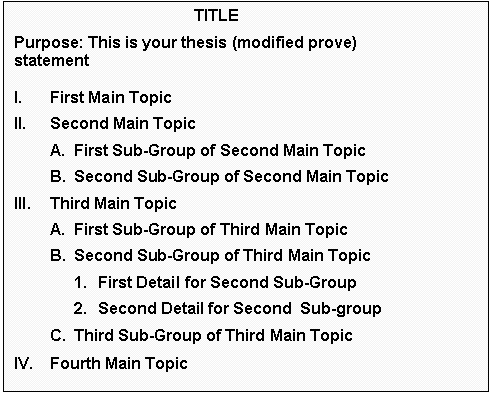
Note the following about the above outline
format:
·
All outline labels (I,II,A,B,1,2)
are followed by a period and two spaces.
·
Sub-groups are indented five
spaces and details are indented ten spaces.
·
If you have an "A" you
must have a "B". There must
always be at least two items when using sub-groups or details. If you don not
have two, then include the information in the previous main point or sub-group.
·
For more specific details,
continue with the following labels: (must follow in this order) small
letters, numbers in parenthesis, small letters in parenthesis.
12.
After your English teacher has
approved your outline, you may then begin writing a rough draft of your
paper. Work on the main points
first. Support your points with
sufficient evidence in the form of facts, examples and other research information. Do not use contractions. They are not used in formal papers.
13.
After the "body" of your
paper is finished, write the introduction and conclusion paragraphs. Use the "keyhole" form that follows
to structure your paper:


Note the
following about the keyhole layout:
·
Each main point has its own
paragraph.
·
You usually state your thesis at
the end of your conclusion statement.
·
In your conclusion, briefly review
what evidence you have used to support your thesis. End your paper with a "clincher"
statement. This is a catchy statement
that emphasizes your topic or thesis. It
can be a cliche', slogan or pun.
15. Now, review your rough draft to see if all your main ideas relate to
each other. Also, see if they relate to
your thesis. If they do not, you may
have to rewrite the paragraphs so that they do.
Be sure that you have supported your main ideas with facts, examples and
other research material.
16. Next, proofread your rough draft, correct all spelling, punctuation and
grammar. Do not continue to the next
step until all the corrections are made.
17. With all your corrections in order, allow a friend to read your
paper. Tell your friend to be honest and
evaluate it according to step number 15 and 16.
Make any corrections or changes after your friend has read it and then go
to the next step.
18. Now we are ready to rewrite your rough draft into your first
version. Remember, just as with a book's
first edition, your paper's first version should be error free and in final
format. Write the main part of your
paper first, making sure to document all facts, quotes and any specific ideas
which are not your own.
Important:
Honesty is the best and safest policy. Remember that copying other's ideas and
claiming they are yours is plagiarism and
is not acceptable. Plagiarism will result in an “F” grade and possibly
additional school or classroom discipline.
When documenting quotes, etc., one way is to put a
raised number behind the quoted sentence.
Then number the next quote with the next number, and so forth. This requires an Endnote Page. This is no longer the standard format even
though some colleges may still require it.
IMPORTANT:
MLA format does not use a raised number or an
“Endnote Page.”
This is the format we will require for this
paper.
The older
format is referenced here only for comparison or future requirements.
MLA's Parenthetical Approach follows this section at #19.
REPEAT: We will be requiring the MLA
Parenthetical
format for all quotes or ideas used in this paper.
Example of the "raised number" format:
Shakespeare demonstrates this idea in Hamlet's
speech, "To be or not to be."1
If you use this format, an endnote page is also
required. The endnote page is a list of
all the sources for the quotes you numbered.
The format is different than the bibliography format.
Traditional Endnote Format:
#. Author's First and Last
Name, The Title of the Book
(City published,
Publishing Company, copyright year), pages quoted.
Example:
2.
Glen E. Dawursk, Jr., How to Write the World's Best Research Paper
(Milwaukee, Wisconsin, Mr.
D Publishing Company, 1999), p. 123.
When you
make the actual page, the heading should simply be NOTES. There is a FIVE space indentation on the
first line only. Finally, there is no
comma after the title. Instead, the
comma should follow the last parenthesis.
19. The MLA's (Modern Language Association's) Parenthetical approach to
documenting quotes or ideas is actually much easier to use than the
"raised/endnote" method above.
After you use the quote or expressed idea in your text, you simply
follow it with the author's last name and
a page number within parenthesis.
The source information will be further explained on your bibliography
page.
MLA
Parenthetical approach:
One Author: (Dawursk 38)
Two to Three Authors: (Dawursk, Meater and Hartman 43)
Use the order of the names on the
book here -- not alphabetical like in the bibliography page.
Four or More Authors: (Dawursk, et al 56)
et al is Latin for "and
more."
Works By The Same Author: (Dawursk, World's Best
12)
The title or a shortened version
of the title comes after the authors last name.
Note the comma between them.
Special Cases: If the
two authors have the same last name, use a first name initial before the last
name. If the article or book has no
author, simply begin with the title of the article in quotes or the book
underlined followed by the page number.
20. If the quote is four lines or less, a summary or a paraphrase then end
the quote with an end quotation mark followed by a space, the parenthetical
reference and a period. For example: "To be or not to be
that is the question" (Shakespeare, 21).
If the quote is longer than 4 lines, indent the entire quote ten spaces
from the left margin. You do not
indent from the left. End the quote or
idea with a period followed by the parenthetical reference.
For example: "Quote...Long
Quote...Really Long Quote...Still More Quote...and even Some More Quote."
(Shakespeare, 23)
21. The Bibliography Page or the Works Consulted Page should be
next. This is a complete list of ALL the
sources you consulted for the paper. It
is in alphabetical order according to the author's last name. The form is outlined after step 5.
Things to remember:
·
The heading is simply
BIBLIOGRAPHY.
·
The actual bibliography is single
spaced;
however, skip a line between each source.
21.
Now redo the outline. The final phrase outline should follow the
same form as your prior one. In fact,
you may not have to make too many changes.
It is just important that the final copy reflect all the points covered
in your final paper. The outline should
be double spaced with an additional line skipped between each main topic (
22.
The last page to write is the
title page. The title page should
include the following:
·
Title of paper
·
Your name
·
Course title
·
Course period
·
Date due.
22. Proofread your paper again.
Correct any additional mistakes. You
will be surprised at how many mistakes get missed the first time around.
23. Finally say a prayer of thanksgiving for what you have learned and for
giving you the ability to complete this project. You are now finished! Congratulations.
DON'T BE LAZY.
DON'T PUT OFF THIS PAPER UNTIL THE LAST WEEK.
START NOW!
Some Quotes about Being Lazy
¨
Lazy hands make a man poor, but diligent hands bring wealth. He who
gathers crops in summer is a wise son, but he who sleeps during harvest is a
disgraceful son. (Proverbs 10:4, 5)
¨
All hard work brings a profit, but mere talk leads only to poverty. (Proverbs 14:23)
¨
The only thing wrong with doing nothing is that you never know when you're
finished. (Unknown)
¨
If a man is lazy, the rafters sag; if his hands are idle, the house
leaks. (Ecclesiastes 10:18)
¨
I used to never finish things, but now I (Unknown)
TITLE PAGE LAYOUT:
The Title of Your Paper Goes Here
By
Your Full Name Goes Here
Class Name
Here
Grade 11
Date Due